Eihei Dōgen
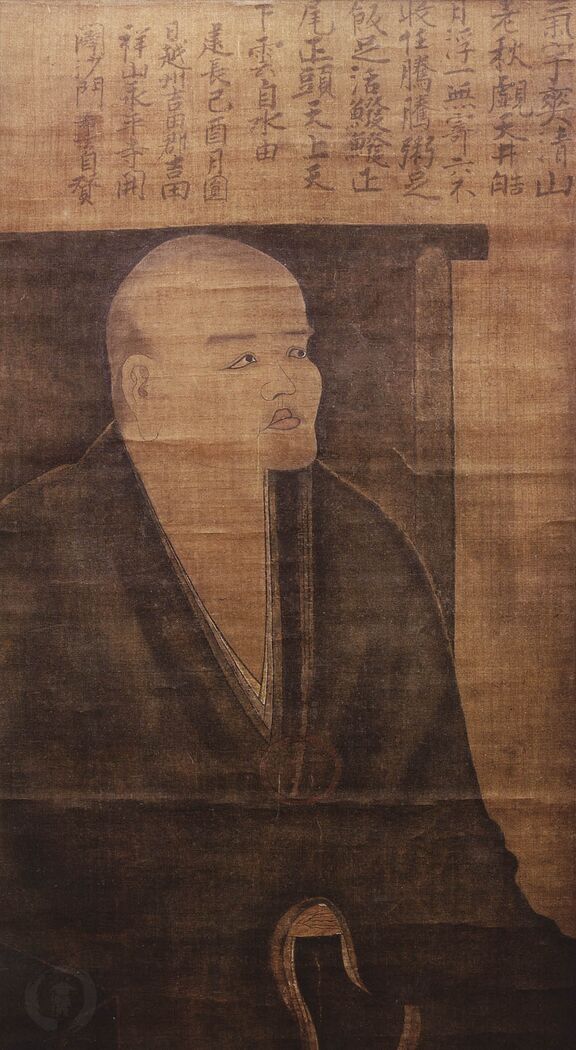
Introduction
Eihei Dōgen (1200–1253) is the founder of the Sōtō Zen school in Japan and one of the most important figures in the history of Japanese Buddhism. His masterpiece, the Shōbōgenzō (正法眼蔵, "Treasury of the True Dharma Eye"), is considered one of the most profound philosophical texts of Zen. He introduced the practice of shikantaza (只管打坐), "just sitting," taught by his Chinese master Tendō Nyojō.
His awakening in China, when he heard Rujing say: "Zen practice must be the dropping away of body and mind (shinjin datsuraku, 身心脫落)," is one of the foundational moments of the Sōtō tradition. Dōgen transmitted this realization to Japan, where it continues to be practiced in Sōtō temples worldwide.
Biography
Dōgen (道元) was born in 1200 in Kyoto into an aristocratic family. His father, Koga Michichika, was a minister of the imperial court; his mother, Fujiwara no Ishi, was the daughter of a high dignitary. Orphaned very young — his father died when he was two, his mother when he was eight — Dōgen was deeply marked by the impermanence of life. This early experience of death drove him toward the monastic life.
At the age of twelve, he went to Mount Hiei, the center of Tendai Buddhism, where he received novice ordination under Kōen. He studied Tendai doctrine and esoteric Buddhism, but a fundamental question haunted him: "If we are already enlightened by nature, why is practice necessary?" This question would become the guiding thread of his entire life.
In 1217, Dōgen left Mount Hiei to study under Eisai (栄西, 1141–1215), founder of the Rinzai school in Japan, at Kennin-ji in Kyoto. After Eisai's death, he continued under Myōzen (明全, 1184–1225), Eisai's successor. In 1223, Dōgen and Myōzen sailed for China, where they stayed at Tiantong Monastery (天童山) under the guidance of Tendō Nyojō (Rujing, 如浄).
It was at Tiantong that the decisive event occurred. During a night zazen session, Rujing addressed the assembly: "Zen practice must be the dropping away of body and mind (shinjin datsuraku, 身心脫落)." The moment Dōgen heard these words, suddenly great awakening occurred. He then went to Rujing's room, lit incense, and prostrated himself. The ensuing dialogue — "Do not give your approval so easily" — shows the depth of his realization.
Dōgen received Dharma transmission from Rujing in 1225 and returned to Japan in 1227. He brought back not texts or precious objects, but "empty hands" — as he himself said: "In the morning, the eyes are horizontal; the nose is vertical."
Back in Kyoto, Dōgen first settled at Kennin-ji, then in 1233 founded Kōshōji (興聖寺) in Fukakusa, on the outskirts of Kyoto. There he composed the first fascicles of the Shōbōgenzō and attracted his first disciples, including Koun Ejō (孤雲懐奘, 1198–1280), who would become his successor and the compiler of the Shōbōgenzō Zuimonki.
In 1243, Dōgen left Kyoto for the mountains of Echizen (now Fukui Prefecture), where he founded Eiheiji (永平寺), the temple that would become the seat of the Sōtō school. He spent the last ten years of his life there, composing the greater part of the Shōbōgenzō and training his disciples. He died in Kyoto in 1253, having entrusted Eiheiji to Koun Ejō. In 1879, Emperor Meiji bestowed upon him the posthumous title of Jōyō Daishi (承陽大師, "Great Master Who Inherits the Light").
The Awakening at Tiantong
The story of Dōgen's awakening is one of the most famous in the entire Zen tradition. It is recounted in the Denkōroku (Case 52) and in the chronicles of Eiheiji:
During a night zazen session at Tiantong temple, Master Rujing addressed the assembly seated in zazen and said: "Zen practice must be the dropping away of body and mind (shinjin datsuraku, 身心脫落)." The moment Dōgen heard these words, suddenly great awakening occurred.
At dawn, Dōgen went to Rujing's private room, lit incense, and prostrated himself. Rujing said: "Why do you burn incense?" Dōgen said: "Body and mind have dropped away (身心脫落來)." Rujing said: "Body and mind dropped away, dropping away body and mind (身心脫落、脫落身心)." Dōgen said: "Do not give your approval so easily (且莫亂印)." Rujing said: "I do not give my approval lightly (我不亂印)." Dōgen said: "What is this not giving approval lightly?" Rujing said: "Dropped away, dropped away (脫落脫落)."
This dialogue is remarkable for its depth. Dōgen refuses easy approval — he does not seek confirmation, but truth. Rujing, by repeating "dropped away, dropped away," shows that even the dropping away must be dropped. This is the heart of Dōgen's teaching: practice is not a means to attain awakening, it is awakening itself in action.
Teachings and Works
Shōbōgenzō — 正法眼蔵
Dōgen's philosophical masterpiece, the Shōbōgenzō ("Treasury of the True Dharma Eye") is a collection of fascicles (95 in the standard version) composed between 1231 and 1253. Each fascicle explores an aspect of Zen practice and realization, blending sutra exegesis, kōan commentaries, and original philosophical reflections. The style is of rare poetic density, using the Japanese language in a wholly new way to express the realities of the Dharma. Fascicles such as Genjōkōan, Bendōwa, Uji ("Being-Time") or Busshō ("Buddha-Nature") are classics of world Buddhist literature.
Eihei Kōroku — 永平広録
Collection of Dōgen's public teachings, compiled by his disciples after his death. It includes sermons (jōdō), kōan presentations, poems, and letters. The Eihei Kōroku offers a more accessible and direct Dōgen than the Shōbōgenzō, with teachings given to monks in the Dharma hall of Eiheiji.
Fukan Zazengi — 普勧坐禅儀
The "Universal Guide for the Practice of Zazen" is the first text Dōgen wrote after returning from China in 1227. This short treatise sets forth the fundamental principles of zazen practice and shikantaza. It is still recited daily in Sōtō temples worldwide.
Shinjin Datsuraku — 身心脱落
The central concept of Dōgen's teaching, shinjin datsuraku ("dropping away of body and mind"), does not denote a particular technique or state, but the very realization of the nature of mind. In the practice of shikantaza, body and mind are "dropped away" not by denying them, but by letting them be in their suchness. This is why Dōgen says: "To practice Zen is to drop away body and mind."
Legacy
Dōgen's influence on Japanese and world Buddhism is immense. He is the founder of the Sōtō school, which is today the largest Zen school in Japan, with over 15,000 temples and millions of practitioners worldwide. His thought has influenced not only religious practice, but also Japanese philosophy, literature, and art.
Outside Japan, Dōgen was rediscovered in the 20th century by philosophers such as Heidegger and Nishitani Keiji. His writings have been widely translated into English, French, and German, and are the subject of academic studies worldwide. The Shōbōgenzō is today recognized as one of the great philosophical texts of humanity.
In the Sōtō tradition, Dōgen holds the place of the 51st patriarch (since Buddha Shakyamuni) and the 1st patriarch of Japan. His lineage continues through Koun Ejō, Tettsū Gikai, and the successive abbots of Eiheiji and Sōjiji.
Sources
CC BY-NC-SA 4.0 — Unless otherwise indicated, the contents of this site are distributed under a Creative Commons Attribution-NonCommercial-ShareAlike 4.0 International License.