Shōji
Introduction
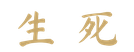
Shōji (生死, "Birth and death") is one of the briefest and most concentrated chapters of Dōgen Zenji's (1200–1253) Shōbōgenzō. It opens with a quotation attributed to the Zen masters Jiashan and Dingshan, whose essential teaching Dōgen takes up and develops in his own way.
The heart of the teaching is radical: birth-and-death is not an obstacle to be overcome in order to reach nirvāna — it is itself the life of the Buddha. To seek awakening outside of birth-and-death is to turn one's back on one's own existence.
The chapter concludes with a surprisingly simple and concrete vision of becoming-buddha: ceasing to cling, rejecting nothing, surrendering to the movement of the Buddha. A path that is "very easy."
Where there is a Buddha in birth-and-death, there is no birth-and-death.
It is also said: where there is no Buddha in birth-and-death, one is not deluded by birth-and-death. These are the words of the two Zen masters known as Jiashan and Dingshan. Since these are the words of persons who have attained the Way, they are not in vain.
One who aspires to be freed from birth-and-death must clarify this principle within oneself. If someone seeks the Buddha outside of birth-and-death, it is like turning one's back to the north to look toward Yue, or facing south while wishing to glimpse the North Star. One only accumulates the causes of birth-and-death in this way, and entirely loses the path of liberation.
One must simply understand that birth-and-death is itself nirvāna. There is then nothing in birth-and-death to flee, nor in nirvāna to desire. It is at that moment, for the first time, that one has some chance of being freed from birth-and-death.
To believe that one passes from birth toward death is a mistake. Birth is a position at a given instant — there is already a before, and an after. This is why in the Dharma of the Buddha, it is said that birth is in itself non-birth.
Death too is a position at a given instant — there is likewise a before and an after. This is why it is said that death is in itself non-death. In what is called birth, there is nothing outside of birth. In what is called death, there is nothing outside of death.
Therefore: when birth arrives, it is simply birth. When death arrives, face death. Do not tell yourself that you must refuse them. Do not desire them. This birth-and-death is the very life of the Buddha.
To wish to reject it and abandon it is to wish to lose the life of the Buddha. To cling to it, to become attached to birth-and-death, is also to lose the life of the Buddha — it is to obstruct the presence of the Buddha.
Rejecting nothing, pursuing nothing — it is then, for the first time, that one enters the heart of the Buddha. Do not measure with thought. Do not formulate with words. Simply abandon your body and mind, cast them into the dwelling of the Buddha, let yourself be set in motion on the side of the Buddha, follow that movement — then, effortlessly, without expending one's heart, one is freed from birth-and-death and becomes Buddha.
Who could remain chained in their heart? There is a very easy path to becoming Buddha: not committing evils, having no heart attached to birth-and-death, having great compassion for all beings, respecting what is above, taking pity on what is below, rejecting nothing, desiring nothing, turning nothing over in the mind, carrying nothing as a worry. This is what is called Buddha.
Translated from classical Japanese based on the text provided by CBETA (Shinshū Taishōzō Taikei Database), University of Tokyo.
Original text in classical Japanese (文語). Shōji, chapter 05. Eihei Dōgen Zenji (1200–1253). Translation: DeepSeek V3.2 via Amazon Bedrock.
CC BY-NC-SA 4.0 — Unless otherwise noted, all content on this site is distributed under a Creative Commons Attribution-NonCommercial-ShareAlike 4.0 International license.