Dainin Katagiri
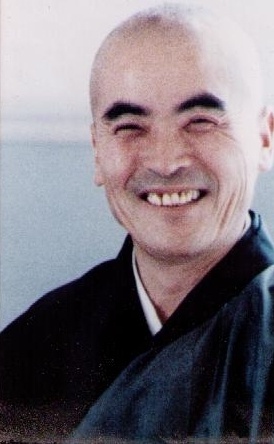
Presentation
Dainin Katagiri (1928–1990) was a Japanese Sōtō Zen master who, after being a disciple and assistant to Shunryū Suzuki in San Francisco, founded the Minnesota Zen Center in Minneapolis. He was one of the first Zen masters to establish himself in the American Midwest, far from the Californian or New York coasts where Zen had first developed. His teaching style, dynamic, frank, and profoundly physical, combined Japanese monastic rigor with an American sensibility. He was known for his booming laugh, his contagious vigor, and his ability to convey the most subtle teachings with disarming frankness.
His phrase — "Zazen is life itself" — expresses his conviction that practice is not separate from daily existence, but is its very foundation.
Biography
Dainin Katagiri (片桐大忍) was born on January 19, 1928, in Osaka, into a family of merchants. From a very young age, he was drawn to religious life. He entered Eiheiji (永平寺), the head temple of the Sōtō school founded by Dōgen, where he received traditional monastic training. At Eiheiji, he learned the rigorous discipline of Sōtō Zen — the long hours of zazen, the complex ceremonies, the intensive manual labor.
After several years at Eiheiji, Katagiri continued his studies at Komazawa University (駒澤大学) in Tokyo, where he specialized in Buddhist philosophy. There he met Shunryū Suzuki (鈴木俊隆), who occasionally taught at the university. Suzuki, about to leave for the United States, perceived in Katagiri a rare energy and sincerity.
In 1963, Suzuki invited Katagiri to join him in San Francisco. Katagiri accepted and became Suzuki's assistant at the San Francisco Zen Center (SFZC). For several years, he assisted Suzuki in all his activities — teaching, sesshins, managing the center — while perfecting his English and adapting to American culture. He was ordained a monk by Suzuki and received Dharma transmission in 1966.
In 1969, Katagiri accepted an invitation to settle in Minneapolis, Minnesota, to found a Zen center there. The American Midwest was then a spiritual desert for Buddhism — there was almost nothing. But Katagiri saw this challenge as an opportunity. He founded the Minnesota Zen Center (MZC) in 1971, with a small group of enthusiastic but inexperienced practitioners.
Les débuts sont modestes. Le centre loue d'abord une petite maison, puis s'agrandit progressivement. Katagiri enseigne avec une énergie inépuisable, donnant des conférences, animant des sesshins, rencontrant des pratiquants un par un. Il est également invité à donner des cours à l'Université du Minnesota, où il enseigne le bouddhisme et la pratique de zazen à des étudiants et des professeurs.
En 1988, il publie son premier livre, Returning to Silence, un recueil de ses enseignements. Le livre reçoit un accueil chaleureux et contribue à faire connaître son approche unique du Zen.
Katagiri meurt le 1er mars 1990 à Minneapolis, des suites d'un cancer du foie, à l'âge de 62 ans. Il laisse derrière lui une communauté florissante et des centaines de pratiquants formés à son enseignement.
Katagiri's Teaching
Katagiri's teaching was marked by a rare intensity. He did not mince words and did not hesitate to confront his students with a frankness that could be disconcerting at first, but which testified to a deep respect for their practice.
He insisted on the importance of physical presence in zazen. For him, zazen was not a mental or spiritual activity — it was a posture, a way of embodying awakening in the body. "Zazen is not thinking about something or thinking about nothing," he would say. "Zazen is being the whole body." He corrected his students' posture with meticulous attention, spending long minutes adjusting the position of the pelvis, the alignment of the spine, the tension in the shoulders.
Il était aussi un maître du kōan vivant. Au lieu de proposer les kōans classiques de la tradition Rinzai, il confrontait ses élèves à des questions tirées de leur vie quotidienne. « Pourquoi es-tu en colère contre ta femme ? », « Qu'est-ce que tu crains vraiment dans ton travail ? », « Pourquoi es-tu assis ici ? » — des questions qui frappaient droit au cœur, délogeant les certitudes et ouvrant la voie à une compréhension plus profonde.
Son humour était légendaire. Il avait un rire puissant qui remplissait la salle de zazen et mettait tout le monde à l'aise même dans les moments les plus sérieux. « Le Zen, disait-il en riant, c'est sérieux, mais pas grave. La vie est sérieuse, mais elle n'est pas grave. Si tu prends tout trop au sérieux, tu rates la beauté de l'impermanence. »
Katagiri enseignait aussi par l'exemple. Il pratiquait zazen tous les jours, sans exception, quelle que soit sa charge de travail ou son état de santé. Même pendant les derniers mois de sa vie, affaibli par la maladie, il continuait à s'asseoir chaque matin avec sa communauté, montrant que la pratique n'est pas une question de circonstances favorables, mais de détermination inébranlable.
Works
Returning to Silence (1988)
Katagiri's first book, a collection of teachings and talks given at the Minnesota Zen Center. The central theme is returning to the fundamental silence that precedes and underlies all existence. Katagiri explores the relationship between silence and speech, practice and daily life, the individual and the community.
Each Moment Is the Universe (1997)
Published posthumously, this collection brings together teachings on the practice of zazen and mindfulness in daily life. The title expresses Katagiri's conviction that each moment contains the entire universe — and that our practice consists of living each moment with total attention.
You Have to Say Something (1998)
Also a posthumous title, this work is an original commentary on the Sandōkai (参同契), the famous Zen poem by Sekitō Kisen (Shítóu Xīqiān, 700–790). Katagiri unfolds his deep understanding of non-duality, showing how unity and diversity interpenetrate in practice and in life.
Legacy
The Minnesota Zen Center, founded by Katagiri in 1971, is today a thriving center that welcomes practitioners from across the American Midwest. It offers regular sesshins, training programs for laypeople and monks, and outreach activities in the Minneapolis community.
Katagiri also trained several teachers who have spread across the United States, perpetuating his unique approach — both rigorous and warm, traditional and adapted to the American context. His influence is felt throughout American Zen, particularly in regions that did not have access to the direct teaching of a master.
His books, published and distributed after his death, continue to inspire practitioners worldwide. Returning to Silence and Each Moment Is the Universe are studied in reading groups and dojos, and his recorded talks circulate widely.
Katagiri remains a unique figure in the history of Western Zen — a master who chose the difficult path of establishing himself far from established centers, in a region of the United States where Buddhism was still almost unknown. His courage, vigor, and compassion continue to inspire.
Quotes
Sources
- Wikipedia — Dainin Katagiri
- Minnesota Zen Center — mnzencenter.org
- Dainin Katagiri, Returning to Silence, Shambhala, 1988
- Dainin Katagiri, Each Moment Is the Universe, Shambhala, 1997
- Dainin Katagiri, You Have to Say Something, Shambhala, 1998
- David Chadwick, Crooked Cucumber: The Life and Zen Teaching of Shunryū Suzuki, Broadway Books, 1999
CC BY-NC-SA 4.0 — Sauf indication contraire, les contenus de ce site sont distribués sous licence Creative Commons Attribution - Pas d'Utilisation Commerciale - Partage dans les Mêmes Conditions 4.0 International.