Kōbun Chino Otogawa
Introduction
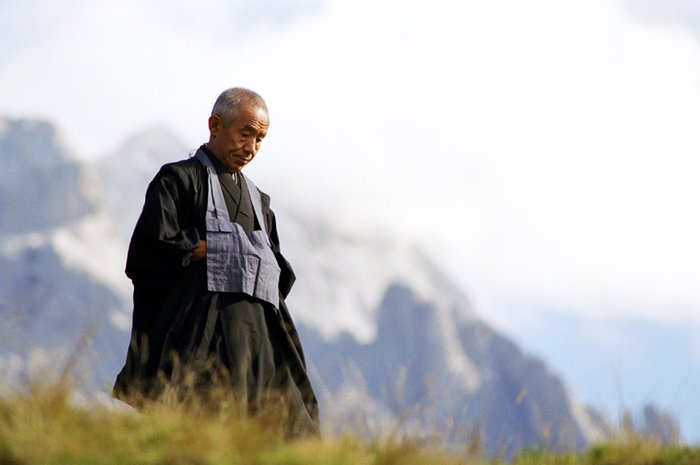
Kōbun Chino Otogawa (1938–2002) was one of the most discreet and profound bridges of Sōtō Zen between Japan and the West. Arriving in the United States in 1967 at the invitation of Shunryū Suzuki, he remained throughout his life a teacher without an institution, without ambition, without staging—attentive to the person standing before him more than to building a school.
He asked to be called simply by his first name, refusing the titles of sensei or rōshi. This sobriety speaks to the essence of his way: a presence, not a function.
Biography
Kōbun Chino Otogawa (乙川弘文) was born on February 1st, 1938 in Japan, the son of a Sōtō priest. He was ordained at the age of twelve—his entry into the path occurring even before adolescence.
He pursued studies at Komazawa University, then obtained a master's degree in Mahayana Buddhism from Kyoto University. He subsequently completed three years of monastic training at Eiheiji, the head temple founded by Dōgen. Among his masters was Kōdō Sawaki, the wandering monk—which makes him, through his training, a close spiritual relative of Deshimaru and the European lineage.
In 1967, he left for San Francisco at the invitation of Shunryū Suzuki and became his assistant at the Tassajara Zen Mountain Center, where he remained until 1970. Upon Suzuki's death in 1971, he took over the leadership of the Haiku Zen Center in Los Altos, which would become Bodhi, and remained there until 1978. He also participated in founding the Santa Cruz Zen Center.
He later founded Hōkōji, near Taos, New Mexico, taught regularly at Naropa University, and in 1983 created the Jikoji retreat center in the Santa Cruz mountains.
He died on July 26, 2002 in Switzerland, while attempting to save his five-year-old daughter Maya, who had fallen from a dock; she also drowned. His death bears the mark of his life: no gesture held back, no hesitation.
Teaching
Otogawa left behind no system. He responded to what presented itself, in the language of the one asking, never placing himself above. His teaching lay more in the manner than in the doctrine—a constant attention to detail, to the body, to the precision of an ordinary gesture.
He placed particular importance on practice in daily life, and on ensuring Zen never became separated from concrete existence: work, relationships, walking, shared silence. What mattered was not understanding well, but being present.
Living Legacy
His Dharma heirs are established on both sides of the Atlantic—notably Angie Boissevain in San José, Martin Mosko in Boulder, Michael Newhall in Los Gatos, and in Europe Vanja Palmers, who taught for a long time in Switzerland.
His influence does not stem from an organization but from a quality of presence, transmitted from person to person. Many Western practitioners today, without knowing it, descend through one link or another from this unassuming master.