Kōdō Sawaki
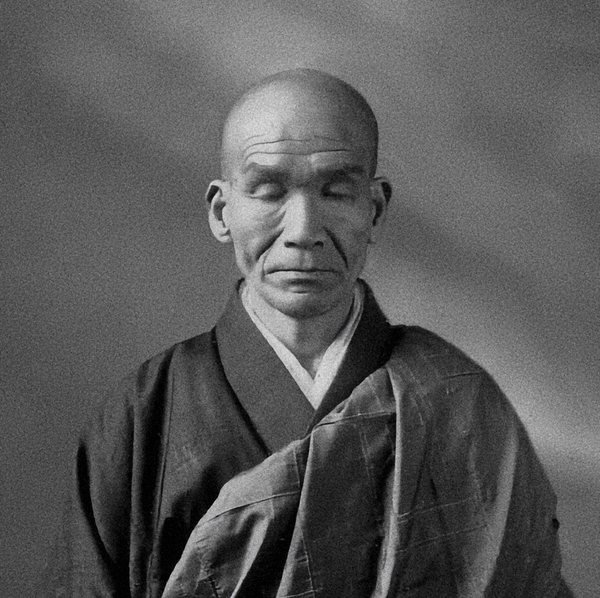
Presentation
Kōdō Sawaki (1880–1965) is one of the most singular and influential figures of 20th-century Sōtō Zen. A wandering monk without a fixed temple, known as "Kōdō the walking monk," he spent his life traveling across Japan to teach zazen to everyone — without distinction of class, education, or belief. He embodied a direct, uncompromising, biting Zen, yet one of rare poetry. He was the master of Taisen Deshimaru, who later brought Sōtō Zen to Europe.
His teaching, centered on the practice of zazen as an expression of absolute freedom, continues to inspire practitioners worldwide. His famous phrase: "Zazen is being free," alone sums up his entire vision of Zen.
Biography
Kōdō Sawaki (澤木興道) was born on June 16, 1880, in Tsu, Mie Prefecture, into a modest family. His birth was marked by tragedy: his father died while he was still a child, and his mother remarried. The relationship with his stepfather was difficult, and Sawaki left the family home very young, at the age of eleven, to work as an apprentice in a small printing shop.
At sixteen, he went to Daichō-ji (大超寺) temple in Mie Prefecture, where he met the monk Kōsen Ōzora (大空宏泉). This was the beginning of his monastic life. He received ordination in 1900, at the age of twenty, and began a life of intensive practice. Very quickly, he distinguished himself by his diligence and determination.
Sawaki then studied under Ōta Jōrei (太田乗嶺) at Bairin-ji (梅林寺) temple, then entered Komazawa University (駒澤大学), the Buddhist university of the Sōtō school, where he followed the teachings of scholarly masters. But Sawaki was not a salon intellectual — he was above all a practitioner. He spent years in kōmyō (monastic pilgrimage), moving from temple to temple, sleeping in zazen halls, cheap inns, or even under the stars.
En 1924, son maître Kōsen Ōzora meurt, et Sawaki prend la direction du temple Antaiji (安泰寺) dans la préfecture de Hyōgo. Antaiji deviendra sous sa direction un lieu de pratique unique, où des moines de toutes origines viennent pratiquer sans distinction. Sawaki transforme le temple en un centre ouvert, refusant les formalités rigides de l'institution Sōtō de l'époque. Il y impose une discipline de fer, mais toujours avec un humour décapant et une liberté de ton qui le rendent célèbre.
Parallèlement, Sawaki enseigne à l'Université Komazawa, où il forme une génération de jeunes moines. Il est également invité régulièrement au temple Zuigan-ji (瑞眼寺) à Matsuyama, où il donne des sesshins (retraites intensives de zazen) restés légendaires par leur rigueur et leur intensité.
Mais ce qui fait la singularité de Sawaki, c'est son refus de se fixer. Il voyage inlassablement à travers le Japon, donnant des conférences, animant des sesshins, rencontrant des pratiquants dans les endroits les plus reculés. On le surnomme « Kōdō le moine qui marche ». Il ne possède rien — ni temple attitré, ni biens personnels — et vit de dons modestes. Son seul bagage est un petit sac contenant son kesa (étole) et un exemplaire du Shōbōgenzō de Dōgen.
Pendant la Seconde Guerre mondiale, Sawaki reste fidèle à sa pratique. Il est arrêté par la police militaire pour avoir refusé de soutenir la propagande nationaliste qui utilisait le bouddhisme à des fins politiques. Il passe plusieurs mois en prison, où il continue à pratiquer zazen assis sur une caisse en bois.
Sawaki s'éteint le 27 décembre 1965 à Tokyo, à l'âge de 85 ans. À son chevet, son plus proche disciple, Taisen Deshimaru, reçoit la transmission du Dharma peu avant sa mort.
Sawaki's Teaching
Kōdō Sawaki's teaching is characterized by a radical rejection of all intellectualism and formalism. For him, Zen is not a philosophy nor a religion in the conventional sense — it is an embodied practice, a way of being fully present in each moment.
His most famous phrase, "Zazen is being free", expresses the essence of his teaching. Zazen is not a means to an end — it serves neither to attain enlightenment, nor to solve one's problems, nor to become better. Zazen is freedom itself, the ultimate expression of our fundamental nature. "Do not do zazen to become a buddha," he says. "Zazen is being a buddha."
Sawaki is known for his direct style, sometimes brutal, often humorous. He does not hesitate to shake up his students with cutting remarks or destabilizing paradoxes. But behind this roughness lies immense compassion and deep respect for each practitioner. "Zen," he said, "is like sitting quietly by the riverbank watching the water flow. Nothing special."
Il aimait aussi répéter que la pratique de zazen n'est pas réservée à une élite de moines ou d'intellectuels. Il enseignait aux pauvres comme aux riches, aux illettrés comme aux savants, aux hommes comme aux femmes. C'est ce qui fit de lui une figure à part dans le paysage monastique japonais, souvent trop hiérarchisé. « Le Zen, disait-il en riant, c'est comme une bonne soupe miso — n'importe qui peut en profiter, il suffit de s'asseoir et de la goûter. »
Works and Influence
Oral Teaching
Sawaki wrote very little. The essence of his teaching has come down to us through the notes of his disciples, notably through the books of Taisen Deshimaru (who transmitted his master's teaching in Europe) and through collections of his informal talks. "Toi, l'Éveillé" and "L'Éveil de la non-pensée" are collections of his words that circulate among practitioners.
The Sutra of the Eye of the True Dharma
His oral commentary on Dōgen's Shōbōgenzō, compiled by his disciples, is a masterful introduction to the thought of the founder of Sōtō. Sawaki had a unique way of making the densest texts accessible, linking them to the direct experience of practice.
Living Legacy
Through Taisen Deshimaru, Sawaki's teaching crossed oceans to take root in Europe. Hundreds of dojos and temples in France, Germany, Italy, and Spain today practice zazen according to Sawaki's lineage. His influence also extends to Japan, where his words are still quoted and meditated upon by generations of monks and laypeople. He remains a model of freedom and authenticity in a world often too formalized.
Quotes
Sources
- Wikipedia — Kōdō Sawaki
- Terebess Online — Kōdō Sawaki
- Taisen Deshimaru, L'Anneau de la Voie, Éditions Courrier du Livre, 1974
- Kōdō Sawaki, Toi, l'Éveillé, Éditions Almora, 2015
- Kōdō Sawaki, L'Éveil de la non-pensée, Éditions du Relié, 2007
- Richard Bryan McDaniel, Zen Masters of Japan, Tuttle Publishing, 2013
CC BY-NC-SA 4.0 — Sauf indication contraire, les contenus de ce site sont distribués sous licence Creative Commons Attribution - Pas d'Utilisation Commerciale - Partage dans les Mêmes Conditions 4.0 International.