Taisen Deshimaru
Presentation
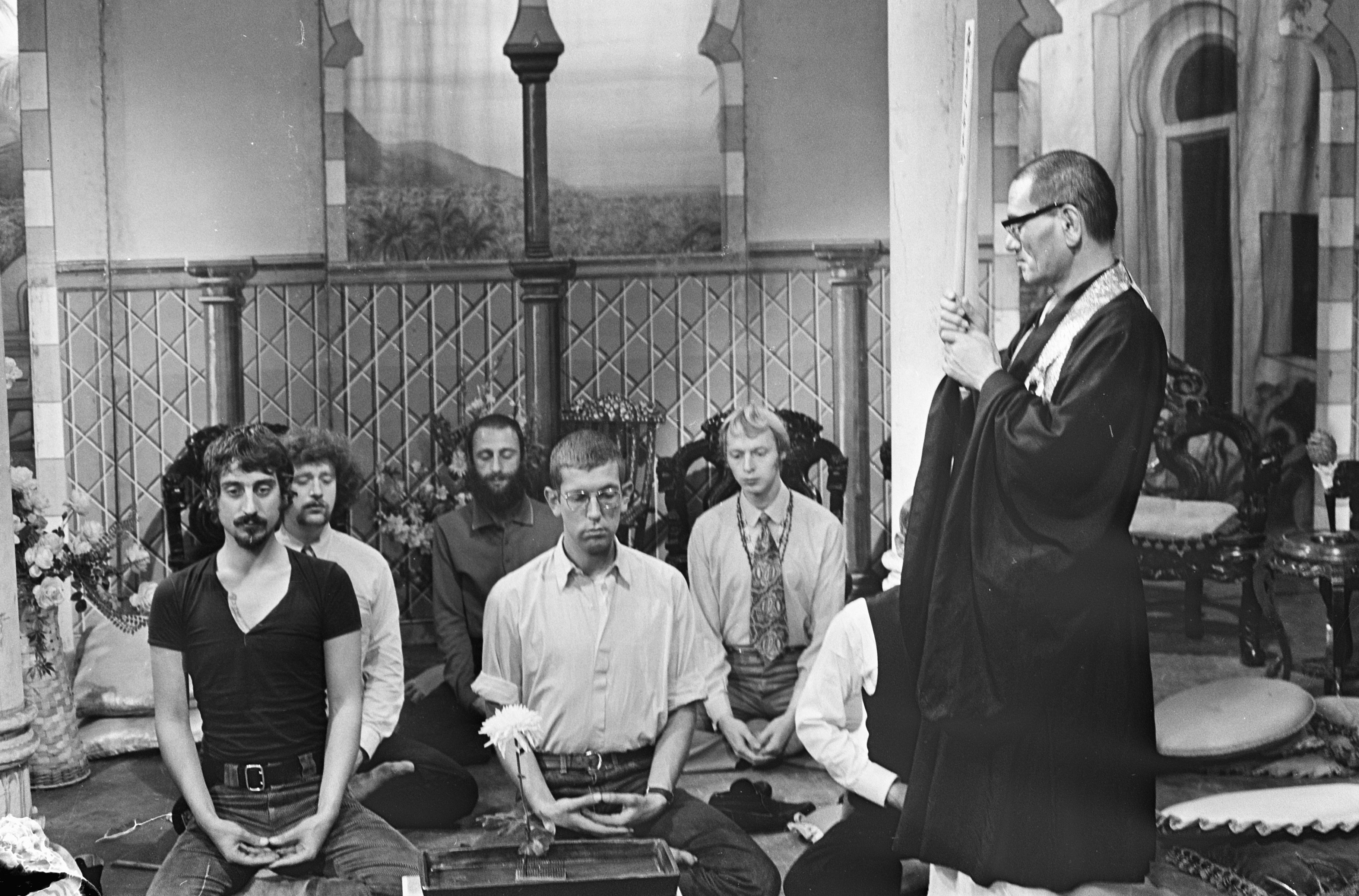
Taisen Deshimaru (1914–1982) is the master who brought Sōtō Zen to Europe and deeply established it there. A direct disciple of Kōdō Sawaki, he arrived in France in 1967 with a single mission: to transmit the practice of zazen to the West. He founded the Association Zen Internationale (AZI) and trained hundreds of practitioners, several of whom themselves became masters — he is the patriarch of almost all European Sōtō Zen. Rigorous yet warm, demanding yet accessible, he embodied a living, concrete Zen, rooted in daily life.
His phrase: "Zen is daily life," resonates as an invitation not to separate practice from life.
Biography
Taisen Deshimaru (弟子丸泰仙) was born on November 29, 1914, in Saga, on the island of Kyushu, into a family of samurai. His father was a naval officer, and Deshimaru's upbringing was steeped in traditional Japanese values — honor, discipline, and respect. As a child, he was fascinated by Buddhism, but it was primarily through reading the works of Dōgen that he discovered his calling.
At University, he studied economics and literature, but his interest in Zen continued to grow. In 1936, he met Kōdō Sawaki (澤木興道), the famous wandering monk, for the first time. This encounter was a shock. Sawaki, with his radical freedom and devastating humor, embodied everything Deshimaru was seeking. He became his disciple and remained so until Sawaki's death in 1965.
During World War II, Deshimaru was sent to Indonesia as an officer in the Japanese army. There he experienced the horror of jungle combat. These experiences marked him profoundly and reinforced his conviction that the practice of zazen is the only true response to human suffering. "In war," he said later, "I saw life naked, without a mask. It is there that I understood what zazen truly is."
Upon his return to Japan, Deshimaru resumed his life as a disciple under Sawaki. In 1965, Sawaki, sensing death approaching, entrusted Deshimaru with a mission: "You must carry Zen to the West. Europeans need zazen." He gave him the Dharma transmission and sent him to Europe.
Deshimaru arrive en France en 1967. Il ne parle pas un mot de français et ne connaît personne. Il s'installe d'abord à Paris, dans une petite chambre du quartier Latin. Les débuts sont difficiles — il donne des conférences devant des salles quasi vides, pratique zazen seul dans sa chambre, vit de peu. Mais peu à peu, des gens viennent : des jeunes en quête de spiritualité, des artistes, des intellectuels, des simples curieux. Tous sont frappés par la puissance tranquille de sa présence.
En 1970, il fonde l'Association Zen Internationale (AZI) et ouvre un premier dōjō à Paris, rue Pernety. Très vite, l'association grandit et des dojos ouvrent dans toute la France, puis en Europe : Allemagne, Italie, Espagne, Belgique, Suisse, Royaume-Uni. Deshimaru voyage sans cesse, donnant des sesshins (retraites intensives), des conférences, des entrevues individuelles. Sa réputation dépasse les frontières de l'Europe — il est invité au Canada, aux États-Unis, en Amérique latine.
En 1974, l'AZI organise la première grande session d'été au château de la Fenderie, en Belgique. C'est un tournant : des centaines de pratiquants de toute l'Europe se réunissent pour pratiquer zazen sous la direction de Deshimaru. Ces sessions deviendront une tradition annuelle, se déplaçant de lieu en lieu (château de la Gendronnière, abbaye de Royaumont, etc.).
Deshimaru retourne au Japon en 1982 pour y être opéré d'un cancer du foie. Il meurt le 30 avril 1982 à Tokyo, à l'âge de 67 ans. Avant de mourir, il confie la direction de l'AZI à ses plus proches disciples — Roland Rech, Étienne Zeisler, Michel Bovay et Pierre Crepon — leur demandant de continuer à transmettre le Zen en Occident. Ses cendres sont rapportées en France et enterrées au monastère de La Gendronnière, dans le Val de Loire.
Deshimaru's Teaching
Deshimaru's teaching is remarkably simple. He constantly insisted on the practice of zazen as the heart of Zen — not as one technique among others, but as the very expression of awakening. "Zen is daily life," he tirelessly repeated. No separation between the meditation hall and the world: the true test of practice is how one lives each moment.
He placed central importance on posture: the back straight, shoulders relaxed, left hand on the right hand, thumbs touching. "The correct posture," he said, "is already zazen. Do not look elsewhere." He ceaselessly corrected his students' positions, sometimes firmly, but always with deep benevolence.
Il insistait aussi sur l'importance du kusen (l'enseignement oral donné pendant zazen) et des dokusans (entretiens individuels avec le maître). Pour lui, la relation directe entre maître et disciple était irremplaçable — c'est là que se transmettait le véritable esprit du Zen, de cœur à cœur, au-delà des mots.
Deshimaru était un enseignant pragmatique. Il adaptait son enseignement à la culture européenne, sans jamais en trahir l'essence. Il traduisait les concepts japonais en termes accessibles, racontait des histoires de son enfance, de la guerre, de sa vie avec Sawaki, rendant le Zen vivant et concret. Il ne demandait pas à ses élèves de devenir japonais — il leur demandait de devenir eux-mêmes, par la pratique de zazen.
Works
The Practice of Zen
His most well-known book, a true manual of zazen for the West. In it, he explains the basics of practice — posture, breathing, mental attitude — and connects them to the teachings of Dōgen and Sawaki. Essential for any beginning practitioner.
Questions to a Zen Master
A collection of questions posed by his students and his answers, often striking in their simplicity and depth. The book shows the master in his daily relationship with his disciples, with his humor, patience, and demands.
The Ring of the Way
A collection of poems and kusen (oral teachings given during zazen), rich with poetic images drawn from nature — rain, wind, mountains. The title evokes the continuity of practice, which has neither beginning nor end.
Other Works
Deshimaru also published commentaries on Dōgen's Shōbōgenzō (The Treasury of the True Dharma Eye), collections of his lectures (Zen and Daily Life), and annotated translations of fundamental Sōtō Zen texts. He also left many audio recordings of his kusen, still used today in AZI dojos.
Legacy
Taisen Deshimaru's legacy is immense. He is the father of European Sōtō Zen. The Association Zen Internationale (AZI) he founded today has dojos in about twenty countries, and hundreds of practitioners gather each year for the sessions he initiated.
His influence extends beyond the strict framework of the AZI. Several of his disciples founded their own communities and lineages, spreading Zen throughout Europe and beyond. The monastery of La Gendronnière, in the Loire Valley, has become a place of pilgrimage for practitioners from all over the world.
Deshimaru also profoundly marked French culture. Among his students were writers, artists, musicians, and filmmakers. His teaching influenced how Zen is perceived and practiced in the West, emphasizing simplicity, accessibility, and grounding in daily life.
Even today, thousands of people practice zazen in Europe in Deshimaru's lineage. His message — "Zen is daily life" — continues to inspire those seeking a concrete spiritual path, free from dogma and beliefs.
Quotations
Sources
- Wikipedia — Taisen Deshimaru
- Association Zen Internationale — azi.org
- Taisen Deshimaru, The Practice of Zen, Éditions du Rocher, 1995
- Taisen Deshimaru, Questions to a Zen Master, Éditions Courrier du Livre, 1977
- Taisen Deshimaru, The Ring of the Way, Éditions du Relié, 1982
- Philippe Coupey, Deshimaru, the Zen Master Who Came from the East, Éditions Almora, 2012
CC BY-NC-SA 4.0 — Sauf indication contraire, les contenus de ce site sont distribués sous licence Creative Commons Attribution - Pas d'Utilisation Commerciale - Partage dans les Mêmes Conditions 4.0 International.