Hakuyū Taizan Maezumi
Presentation
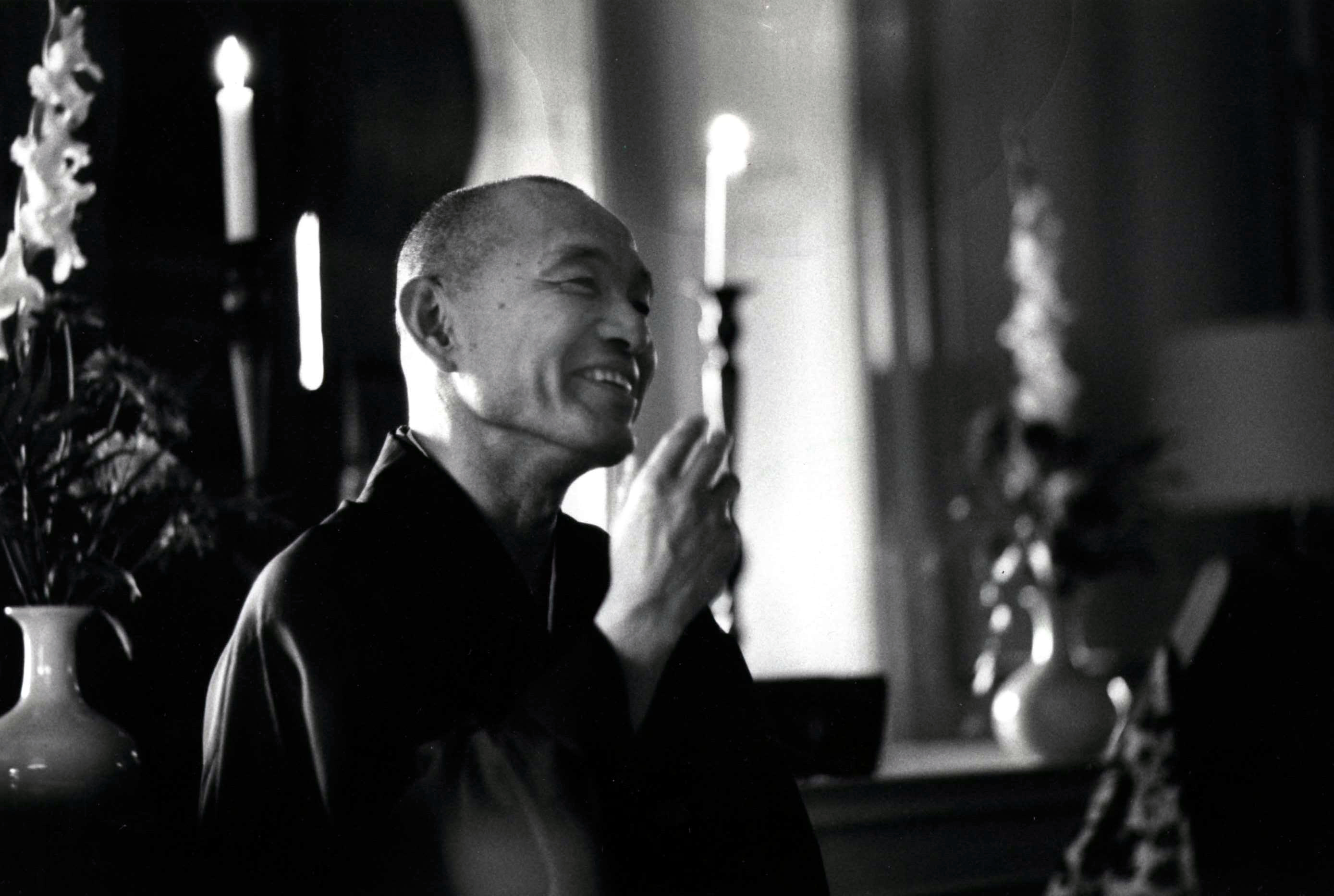
Hakuyū Taizan Maezumi (1931–1995) is an exceptional Zen master who received Dharma transmission in the three Japanese Zen schools — Sōtō, Rinzai and Sanbō Kyōdan. He founded the Zen Center of Los Angeles (ZCLA), one of the most important Zen centers in the United States, and trained a generation of American masters who spread across the entire continent: Bernie Glassman, John Daido Loori, Charlotte Joko Beck, Dennis Genpo Merzel, and many others. His teaching, combining traditional rigor with profound humanity, remains a reference for Western Zen.
His phrase — "Every moment is an opportunity" — reflects his conviction that practice is not limited to the zazen hall, but embraces every aspect of existence.
Biography
Hakuyū Taizan Maezumi (前角博雄) was born on February 24, 1931 in Ōtawara, Tochigi Prefecture, into a family of Sōtō monks. His father, Hakujun Kuroda (黒田白純), was a respected Sōtō master, abbot of Kōfuku-ji temple. At a very young age, Maezumi was initiated into monastic life. He received novice ordination at the age of eleven and began intensive training under his father.
At nineteen, he entered Komazawa University (駒澤大学) to study Buddhist philosophy. Simultaneously, he continued his practice under his father's direction and received Sōtō Dharma transmission in 1955.
But Maezumi was not satisfied with just one school. He felt the need to deepen his understanding of the other branches of Zen. He went to Chōtoku-in temple to study Rinzai Zen under the direction of master Hakuun Yasutani (安谷白雲, 1885–1973), founder of the Sanbō Kyōdan (三宝教団, "Order of the Three Treasures"), a school that integrates Sōtō and Rinzai practices. Yasutani was a renowned kōan master, and Maezumi underwent intensive training under his direction, receiving transmission in the Sanbō Kyōdan lineage and complete mastery of the Rinzai kōan system.
In 1956, Maezumi left for the United States, first to study English in Los Angeles. There he met Shunryū Suzuki (鈴木俊隆), who had recently arrived in San Francisco. Suzuki, impressed by the young monk's spiritual maturity, invited him to teach in San Francisco and recognized him as an accomplished master.
In 1967, Maezumi founded the Zen Center of Los Angeles (ZCLA), which would become one of the most influential Zen centers in the United States. The center quickly attracted serious students, and Maezumi trained a generation of masters who would spread across the entire country: Bernie Glassman (founder of the Zen Peacemaker Order), John Daido Loori (abbot of Zen Mountain Monastery), Charlotte Joko Beck (founder of the Zen Center of San Diego), Dennis Genpo Merzel (founder of the Kanzeon Sangha), John Tarrant (Pacific Zen Institute) — to name only the most famous.
En 1974, Maezumi retourne au Japon pour recevoir la transmission dans la lignée Rinzai du maître Shunryū Suzuki (une seconde transmission de la part de Suzuki, cette fois dans la tradition Rinzai). Il est désormais l'un des rares maîtres à détenir la transmission dans les trois écoles du Zen japonais — Sōtō, Rinzai et Sanbō Kyōdan.
La vie de Maezumi n'est pas exempte de difficultés. Il traverse des périodes de doute et de conflits. Sa relation avec l'alcool est connue et il en parle ouvertement, avec une honnêteté qui déconcerte parfois ses élèves mais qui témoigne de sa profonde humanité. « Je ne suis pas un saint, disait-il. Je suis un humain qui pratique. C'est tout. »
Maezumi meurt le 15 mai 1995 à Tokyo, à l'âge de 64 ans, des suites d'une maladie. Sa mort est une perte immense pour le Zen occidental, mais son héritage perdure à travers ses disciples et les centres qu'il a fondés.
Maezumi's Teaching
Maezumi's teaching is distinguished by its unique synthesis of the different Zen traditions. Having received transmission in the three schools, he drew freely from Sōtō methods (shikantaza, silent sitting) and Rinzai methods (kōan study) without confining himself to one or the other. "Truth is one," he said, "but the paths are many. One must not confuse the path with the destination."
He placed central importance on the master-disciple relationship. For him, Dharma transmission was not an administrative formality, but a living exchange, a deep recognition between two beings. He spent a lot of time with his students — in individual interviews (dokusan), shared meals, walks — creating bonds that lasted a lifetime.
Il était un maître exigeant, mais d'une exigeance qui venait de l'amour et du respect pour ses élèves. « Je ne te pousse pas pour te faire souffrir, disait-il. Je te pousse parce que je sais ce que tu es capable d'être. » Beaucoup de ses disciples témoignent de sa patience infinie et de sa capacité à voir le potentiel d'éveil chez chacun, même chez ceux qui semblaient les plus perdus.
Maezumi était aussi un maître de la vie ordinaire. Il aimait cuisiner, jardiner, jouer avec les enfants. Il montrait que le Zen n'est pas une affaire de prouesses spirituelles, mais d'attention à chaque geste, à chaque instant. « Faire la vaisselle, disait-il en riant, c'est aussi important que s'asseoir en zazen. Peut-être plus — parce que c'est plus difficile d'y être vraiment présent. »
Works
The Way of Everyday Life
Translation and commentary on the Hsin-hsin Ming (信心銘, "Inscription on Faith in Mind") by Sosan (Sēngcàn, the 3rd Chinese patriarch). Maezumi unfolds his deep understanding of non-duality, showing how every aspect of daily life is an expression of the Dharma.
Appreciate Your Life (2001)
Posthumous collection of Maezumi's teachings, gathering his most striking talks. The title reflects his conviction that gratitude and appreciation of every moment are the heart of spiritual practice.
Hakuyū Journal
A personal journal in which Maezumi recorded his reflections on practice, his doubts, his realizations. Excerpts were published after his death, offering a rare and precious glimpse into the inner life of a Zen master.
Legacy
Maezumi's legacy is remarkable for its breadth and diversity. He trained more than twelve masters who spread across the United States and the world, founding their own centers and communities:
- Bernie Glassman — Zen Peacemaker Order (New York, founded in 1980)
- John Daido Loori — Zen Mountain Monastery (New York, founded in 1980)
- Charlotte Joko Beck — Zen Center of San Diego (founded in 1978)
- Dennis Genpo Merzel — Kanzeon Sangha (Utah, founded in 1984)
- John Tarrant — Pacific Zen Institute (California, founded in 1990)
The Zen Center of Los Angeles (ZCLA) continues to be an active and influential center, offering intensive training programs, retreats, and public teachings. It is now led by Maezumi's spiritual successors.
Maezumi also played a pioneering role in adapting Zen to Western culture. He knew how to preserve traditional rigor while opening the practice to men and women from all backgrounds — including families, people engaged in professional life, and people recovering from addictions. His inclusive and human approach paved the way for all of modern American Zen.
His honesty about his own difficulties — notably his struggle with alcohol — also helped demystify the image of the perfect and inaccessible Zen master, showing that the path is not reserved for exceptional beings, but for ordinary humans who sincerely engage in practice.
Transmission in Three Schools
Hakuyū Taizan Maezumi is one of the very few masters in the history of Zen to have received official Dharma transmission in the three main Japanese Zen schools:
- Sōtō Zen (曹洞宗) — Transmission received from his father Hakujun Kuroda in 1955
- Sanbō Kyōdan (三宝教団) — Transmission received from Hakuun Yasutani following intensive training in the kōan system
- Rinzai Zen (臨済宗) — Transmission received from Shunryū Suzuki in 1974
This triple transmission testifies both to the depth of his personal realization and to his open-mindedness. He did not consider the schools as rival traditions, but as complementary expressions of the same truth. This ecumenical attitude, rare in the Japanese religious landscape, deeply marked his disciples and influenced the development of Zen in the West.
Quotations
Sources
- Wikipedia — Taizan Maezumi
- Zen Center of Los Angeles — zcla.org
- Hakuyū Taizan Maezumi, Appreciate Your Life, Shambhala, 2001
- Hakuyū Taizan Maezumi, The Way of Everyday Life, Shambhala, 1978
- Bernie Glassman, Bearing Witness: A Zen Master's Lessons in Making Peace, Harmony, 1998
- John Daido Loori, The Eight Gates of Zen, Shambhala, 1992
- Charlotte Joko Beck, Everyday Zen, HarperOne, 1989
CC BY-NC-SA 4.0 — Sauf indication contraire, les contenus de ce site sont distribués sous licence Creative Commons Attribution - Pas d'Utilisation Commerciale - Partage dans les Mêmes Conditions 4.0 International.